
What really happens during a Yoga Teacher Training weekend?
Friday Evening
You arrive after a week of work, family, responsibilities, and everyday life. At 19:30, the room slowly becomes quiet.
We might begin with a mantra, a short yoga practice, or meditation. Nothing complicated—just enough to make the transition from everything that happened before to being here.
And then the weekend begins.
Not with a long list of things you have to remember, but with an invitation to practise, experience, ask questions, and explore.
Because at Yogalife, we don't believe Yoga Teacher Training is simply about learning techniques. If it were, why couldn't we just learn them from the internet?
- You can watch a video of a yoga posture.
- You can learn a breathing technique.
- You can follow a meditation.
- You can even learn how to structure a yoga class.
But yoga is not just information.
First, Experience
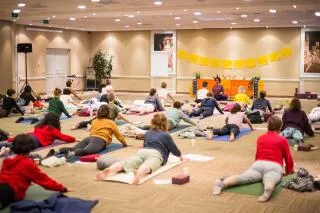
Saturday morning begins with practice. A 90-minute yoga class gives students the opportunity to experience what they will later study and teach.
Before asking “How do I teach this?”, we ask:
- What do I experience?
- How does my body respond?
- What happens to my breath?
- What do I notice in my mind?
- What changes when I stay with a posture for longer?
The practice becomes our first teacher.
And then we take a break. A nourishing breakfast. A cup of tea. A conversation. Sometimes laughter. Sometimes someone simply needs to sit quietly for a few minutes. There is space for all of it.
Then we come together again. Often, we begin the next session with mantra. Not simply to learn how to chant or because it is part of the tradition, but because it creates a different quality of attention—a moment to settle, to listen, to become present.
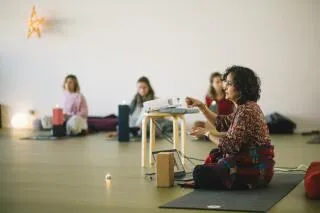
And then we start studying. But a lecture at Yogalife is not a monologue. This is something we feel is very important.
Students don't come empty-handed. They arrive with their own experiences, questions, doubts, observations, and sometimes even completely unexpected questions. And those questions become part of the teaching.
- One question can open another.
- One student's experience can help another student understand something differently.
Sometimes we stop and discuss. Sometimes we demonstrate. Sometimes we practise. Sometimes we simply ask: “What did you experience?”
The classroom becomes a place for conversation rather than one-way teaching.
Learning by Doing
Throughout the training, students are given practical exercises. You may be asked to:
- Observe something in your own practice.
- Work with another student.
- Explore a posture.
- Teach a small part of a class.
- Observe how someone else moves.
- Reflect on a question.
- Try something, make a mistake, discuss it—and try again.
This is where learning becomes interesting. Because you are not just sitting there thinking, “I understand.” You are actually finding out: “Can I do it?” And perhaps more importantly: “What did I learn from doing it?”
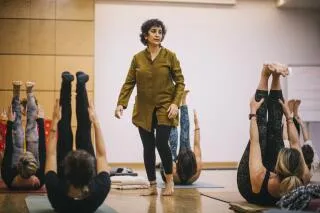
How We Teach: Yogalife's TTC introduces students to teaching from the beginning, rather than waiting until the end of the course. The programme combines theory with practical teaching, observation, and hands-on learning.
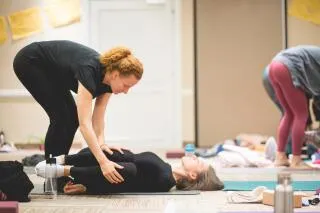
After lunch, we look at the body differently. The afternoon may bring us back to yoga postures, but again, the question isn't simply: “How do I make this posture look right?”
We begin with ourselves. We learn to understand our own body, then we begin to observe another person's body. Two people can be in the same posture and experience something completely different:
- One person may need more space.
- Another may need support.
- Another may need to change the posture completely.
So we learn to see rather than assume—to observe, to ask, to understand, and eventually, to guide.
This is where the posture becomes much more than a shape; it becomes a way of understanding the person practising it.
Yogalife's programme specifically includes applied anatomy, asana teaching methodology, corrections, and a hands-on asana clinic.
The Space in Between
Not every part of a training weekend is teaching. There is lunch. There are conversations. There are moments when students sit together and suddenly discover they have much more in common than they thought.
There are also people who use the break to be alone—to rest, to recharge, to process what they have learned. Because a training needs space for learning to settle.
Built for Real Life: Yogalife moved from an intensive month-long format to a nine-weekend structure so people with jobs, families, and other responsibilities can continue their lives while having time between weekends to process the teachings.
Eventually, we return to the mat. After a full day of studying, questioning, practising, and teaching each other, we often end with a quieter, more relaxing practice.
The pace slows down. The body settles. The mind becomes quieter. And perhaps something from the day begins to make sense.
Then we go home. Not with the feeling that we have finished learning, but with:
- Something to think about.
- Something to practise.
- Something to observe during the week.
- And sometimes, a new question.
What is Yoga Teacher Training Really About?
Is it about becoming more flexible? Learning more postures? Getting a certificate? Learning how to teach a class?
All of these can be part of the journey, but they are not the whole picture. Yoga Teacher Training is an opportunity to look at the whole person:
- The body
- The breath
- The mind
- Our habits
- Our reactions
- Our awareness
- Our relationship with ourselves and with others
At Yogalife, the training is designed not only for people who want to become teachers, but also for those who want to deepen their own understanding and practice. The programme describes yoga as something that extends beyond asana and into everyday life.
Because before we teach someone else how to practise yoga, we have to practise meeting ourselves.
And perhaps that is what makes a Yoga Teacher Training weekend so special: you come to learn yoga, but somewhere between the practice, the questions, the conversations, the exercises, the laughter, the mistakes, and the quiet moments... you start experiencing it.
And that is where learning becomes transformation.